

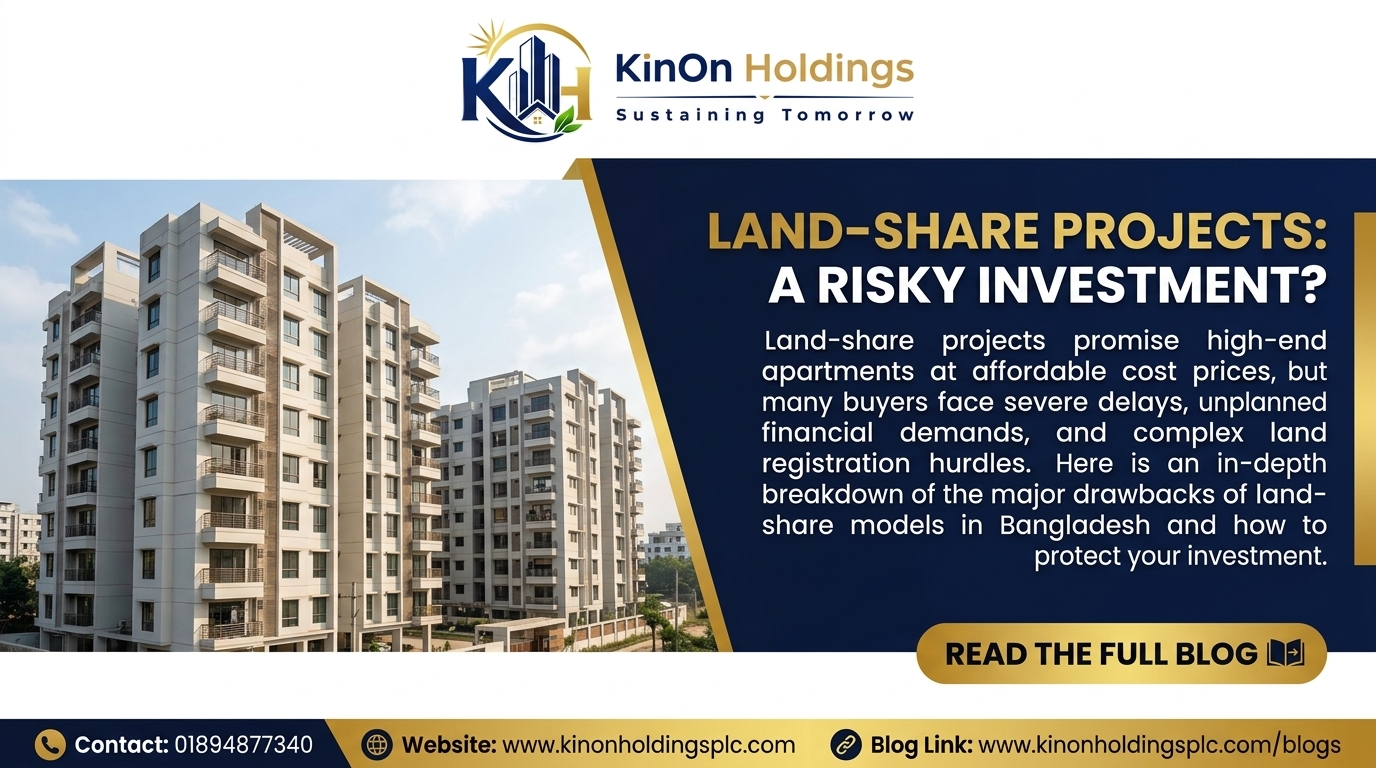
In recent years, "Land Share" real estate projects have surged in popularity across Bangladesh, particularly around the outskirts of Dhaka, Chittagong, and other major urban hubs. Marketed as an affordable alternative to traditional apartments, these schemes promise buyers shared ownership of a land plot followed by joint construction at cost price. On paper, it sounds like the ultimate dream: luxury living at half the market price.
However, for thousands of middle-class families and Non-Resident Bangladeshis (NRBs), this dream can turn into a long-lasting nightmare. Behind the glossy brochures and flashy social media advertisements, there may lurk structural delays, legal loopholes, financial mismanagement, and outright fraud.
Here is an honest look into the bad experiences surrounding land-share projects in Bangladesh and what you need to know before investing your hard-earned money.
1. What is a Land-Share Project?
In a standard land-share model:
1.1. A developer or entrepreneur identifies a plot of land and calculates the total cost of purchasing it. (In the case of large projects, there may be multiple developers)
1.2. The land is divided into fractional "shares" matching the total number of planned apartment units.
1.3. Buyers purchase a portion of the land, register their share, and subsequently pay construction costs—either monthly or in installments—to build the structure collectively. (Commercial entities typically charge a service fee of 8–10%.)
Although this concept originated as a small-scale cooperative arrangement among friends or trusted colleagues, implementation often suffered from issues regarding construction quality and mismanagement. Later, professional companies started this model—incorporating a specific service charge—to assist the general public with luxury living and investment planning. Unfortunately, a segment of commercial land-share operators often exploits loopholes in the system (these being the unprofessional ones).
2. Common Bad Experiences and Scams Reported by Buyers
2.1. Non-Existent or Disputed Land Ownership
One of the most widespread issues is selling shares on land that the developer does not actually own or fully control.
• Power of Attorney Traps: Developers often sign a temporary agreement with landowners without securing an irrevocable Power of Attorney or complete transfer of ownership.
• Government/Canal Encroachments: Many low-cost projects are mapped on low-lying floodplains, government-owned (Khas) land, or natural water bodies (like wetlands around Purbachal or Aminbazar) where permanent construction is strictly illegal.
2.2. Severe Delays and Abandonment
Traditional developers face legal and brand consequences when projects stall, but land-share organizers often shift the responsibility onto the share-buyers.
• Once the land is registered, organizers frequently demand higher construction installments than initially promised.
• When buyers object or fail to pay inflated costs, construction grinds to a complete halt. It is common to find land-share projects in Dhaka standing as bare concrete skeletons for 5 to 10 years without progress.
2.3. Undisclosed Costs and Financial Escalation
Initial estimates provided by land-share companies are often unrealistically low to attract buyers. Once you are locked in:
• Developers introduce hidden costs—utility connection fees, registration surcharges, interior foundation add-ons, and unexpected material cost adjustments.
• The total cost frequently ends up matching or exceeding the market rate of a standard finished apartment from a reputable developer.
2.4. Missing RAJUK / CDA Approvals
In Dhaka, RAJUK (and in Chittagong, CDA) regulations strictly govern floor-area ratios (FAR), building height, and safety compliance.
• Unprofessional land-share organizers often sell more shares than the regulations governing building construction on a specific plot allow in terms of the number of units and building height.
2.5. Lack of Legal Accountability
Since land-share models are frequently structured as joint buyer cooperatives rather than standard buyer-developer contracts, developers often bypass consumer protection laws (such as the Real Estate Development and Management Act, 2010). When disputes arise, developers claim they were merely "coordinators," leaving individual shareholders to become embroiled in internal legal battles with one another.
3. Red Flags to Watch Out For
If you are considering a land-share investment, be extremely cautious if you spot any of the following:
• Unbelievably Low Prices: If the price per square foot is less than 50% of the surrounding area's prevailing rate, there is almost certainly a catch.
• Non-compliant construction planning: This occurs if the developer fails to prepare a layout plan or design for the specific plot in accordance with the regulations of RAJUK or the local authority. In this regard, it is essential to have a basic understanding of factors such as the required setback percentage (20–30%) and the permissible building height.
• Agricultural or Unfilled Land: The land is under water, un-demarcated, or still classified as agricultural (Nal) land in government records.
• Use Tactics for Payment: Promoters pushing for quick booking money before allowing your lawyer to inspect original land deeds (Khatian, Mutation, CS/SA/RS/BS Porcha).
4. How to Safely Evaluate a Land-Share Opportunity
If you still wish to pursue a land-share arrangement, follow these essential safeguards:
4.1. Avoid Unprofessional Developers: Any developer exhibiting one or more of the issues mentioned in point #3 above should be considered unprofessional.
4.2. Verify Layout Approvals: Ensure the plot has clearance from the relevant urban planning authority (e.g., RAJUK, CDA, KDA) and environmental clearance if located near wetlands.
4.3. Inspect the Physical Site: Visit the physical site yourself. Check if the plot is demarcated with boundary walls and verify whether the surrounding infrastructure (roads, electrical lines) actually exists.
4.4. Form a Buyers' Committee: Instead of placing total financial control in the hands of a single organizer, the bank account and construction funds can be managed directly by the committee.
Final Thoughts
Land-share projects can work when executed transparently among Professional & trusted groups. However, when commercialized by unverified organizers, they carry significant financial and legal risks. Prioritize legal due diligence, verified approvals, and financial transparency over flashy marketing to protect your family's savings. Also, you must have to know about standard construction costs which are BDT 2400 for professional companies and 4500 sft for branded professional companies based on present raw material cost. Over time, current costs are bound to rise rather than decrease; any deviation from this norm indicates an unprofessional company. Therefore, simply by reviewing the aforementioned factors, one can easily distinguish between professional, reputed professional, and unprofessional companies. It is certainly unwise to engage in dealings with unprofessional developers. Avoiding decisions regarding one's dream home or investment planning based solely on false allure and the sweet rhetoric of advertisements would be one of the best decisions of your life.